

Anthropic, the maker of the Claude family of AI models, listed on Nasdaq on November 19th at US$83 per share. The listing is among the largest technology IPOs on record and has drawn attention due to its position in the global AI race, its rapid revenue growth, and the scale of its future spending commitments. We offer this primer to set out the company's business model, financial profile, competitive position, and the principal issues investors are likely to weigh. For Idea Generation only, not official recommendation.
CIO Summary
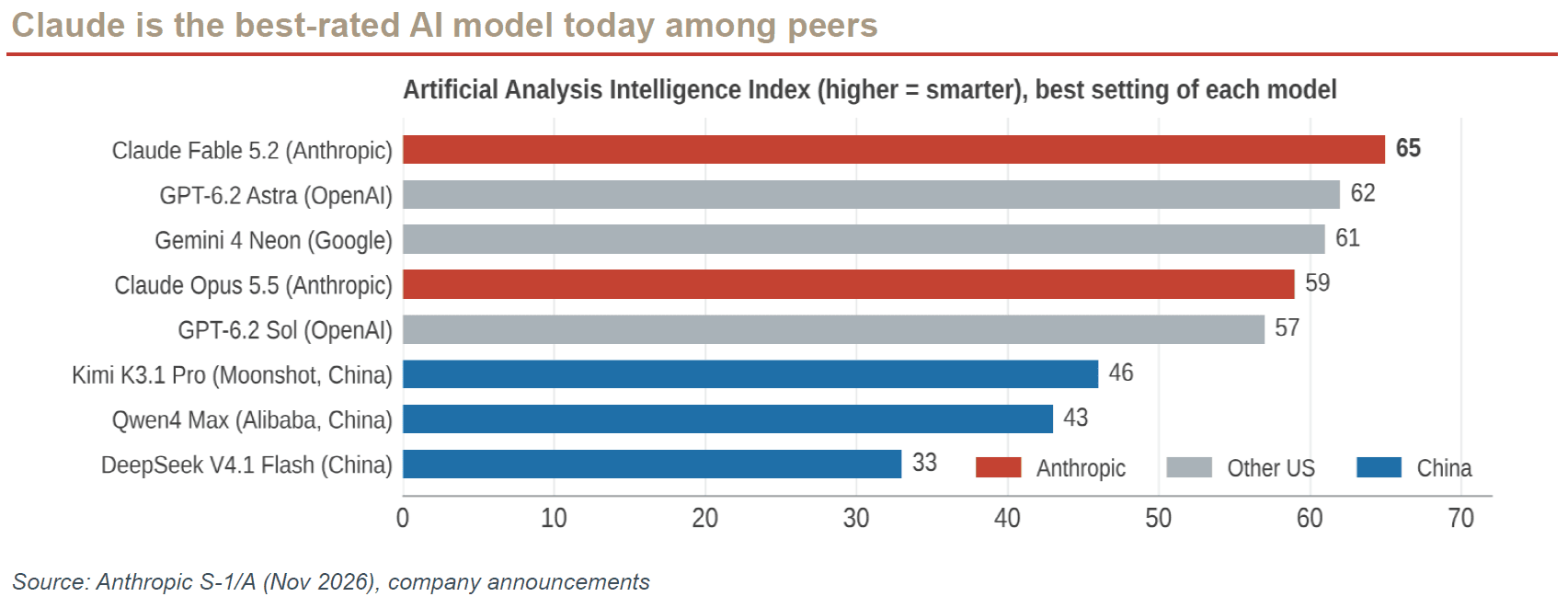
- Leading the AI race. Anthropic’s leading model, Claude Fable 5.2, ranks No.1 on the Artificial Analysis Intelligence Index, scoring 65 vs 62 for OpenAI and 61 for Google. On Epoch AI’s index, the US lead over China has widen to roughly six to seven months of progress. Anthropic’s listing underscores the US lead in frontier models amid the US-China AI Race, which remains one of our top predictions for 2027.
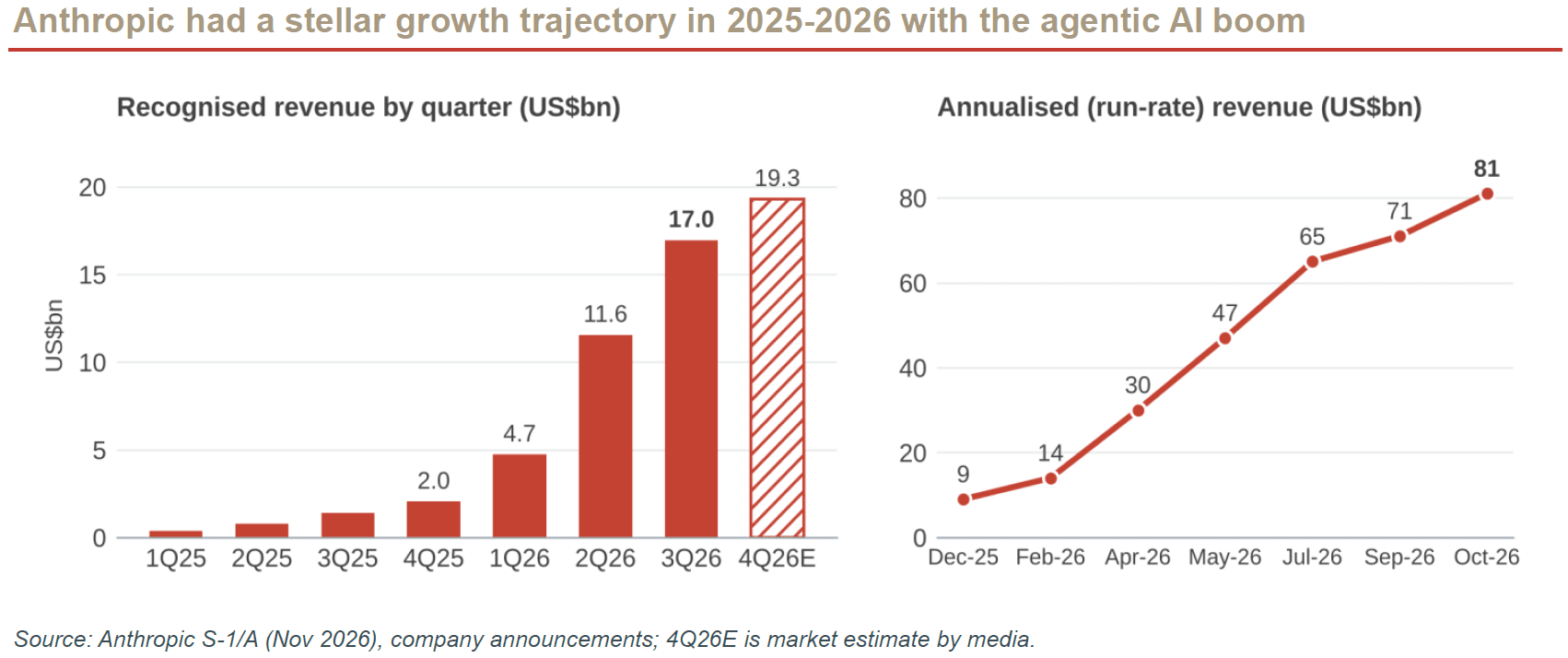
- Strong growth profile. Anthropic’s 3Q2026 revenue was US$17bn, more than 12 times the prior year level, and annualised 2026 revenue reached US$81bn in October. Operating cash flow was a positive US$6.6bn in the first nine months of 2026.
- Valuation context. At the US$83 IPO price, Anthropic is valued at US$1.5tn on a fully diluted basis, or ~18.6x annualised revenue by October’s print. ANT is already valued like big tech: it grows far faster than any of the big tech names in the US, but its margins are well below.
What Anthropic does: the company was founded in 2021 by former OpenAI researchers and builds the Claude family of AI models. Businesses use Claude through Anthropic’s own platform, through the cloud services of Amazon, Google and Microsoft, and through apps such as Claude Code, its AI programming assistant. 79% of its revenue is pay-per-use, the rest subscriptions. Anthropic is a PBC (public benefit corporation), which means it is legally required to weigh its safety mission alongside shareholder returns.
Business Highlight
Anthropic’s Claude is the best-rated AI model today. Fable 5.2, launched on 9 Nov, ranks No.1 on the Artificial Analysis Intelligence Index with a score of 65, ahead of OpenAI's GPT-6.2 Astra (62) and Google's new Gemini 4 Neon (61). Note that leadership in model rankings can change quickly.
- Anthropic’s model is the best-rated but not the cheapest: at its highest setting, Fable 5.2 costs about 6.6 times as much as Astra to complete the same test task (US$26.54 vs US$4.00), while taking three times as long. Customers are willing to pay the premium for hard tasks such as complex coding, where cheaper models are good enough for routine tasks.
- Each release is also cheaper to run: Opus 5.5 completes a typical task at roughly 40% lower cost than Opus 5. That supports adoption, but it also means usage must grow faster than prices decline. So far it has.
Companies are building Claude into their daily work
- The biggest share of business spending. Anthropic takes 55% of what US companies spend on AI models, ahead of OpenAI (31%) and Google (9%), according to a Menlo Ventures survey. Payments data from Ramp, covering ~85,000 US businesses, show 44.8% firms paid for Anthropic in October vs 40.6% for OpenAI.
- Hard to replace once it is in. Once Claude is wired into a company’s systems, data permissions and workflows, switching will cost time and money. Claude Code is the product that pulls big customers in, with Anthropic’s top 5% customers spending ~20 times vs. a typical business user.
- Retail is the weak spot. Claude has ~245m monthly consumer users, against more than 1bn each for ChatGPT and Gemini. Cheap open models, led by Chinese labs, already carry about a fifth of business AI usage, though they earn only about 4% of the spending, according to Menlo Ventures.
A shot at the biggest prize in tech: AGI
- AGI (artificial general intelligence) usually means AI that can do most knowledge work at a human level or higher. Nobody knows when, or whether, it will arrive. But there are early signs at Anthropic: Claude wrote over 90% of Anthropic’s new code in September. In its IPO filing, Anthropic says it “may imminently” reach the point where its AI significantly speeds up its own research.
- Why it matters? If AI starts speeding up AI research, the leader could pull further ahead. That justifies some premium for Anthropic. Meanwhile, Anthropic's safety-first structure may create a risk that it moves slower than rivals, a trade-off that investors need to assess.
Other Issues Investors Should Weigh
- Anthropic’s biggest partners are also its suppliers, shareholders and rivals. Amazon (~15%) and Google (~14%) are the largest shareholders. They also sell Claude on their clouds (together with Microsoft), supply much of Anthropic’s computing power while compete with their own models. Seven suppliers, including Google and Nvidia, are buying US$26bn of Anthropic’s IPO shares. In effect, some of the money Anthropic spends with these suppliers comes from the suppliers themselves.
- The co-founders hold 50.1% of the votes through a special share class, and an independent trust elects most of the board. Public shareholders cannot overturn safety-first decisions.
- Watch the share supply/demand. Only ~7.4% of Anthropic’s shares trade freely. Up to ~315m insider shares can be sold from day one and ~1.6bn within 76 days, with a large lock-up expirty around mid-May 2027. On the other side, ANT is expected to join the Nasdaq-100 around late Dec, which could bring index-fund buying.
Financial Profile
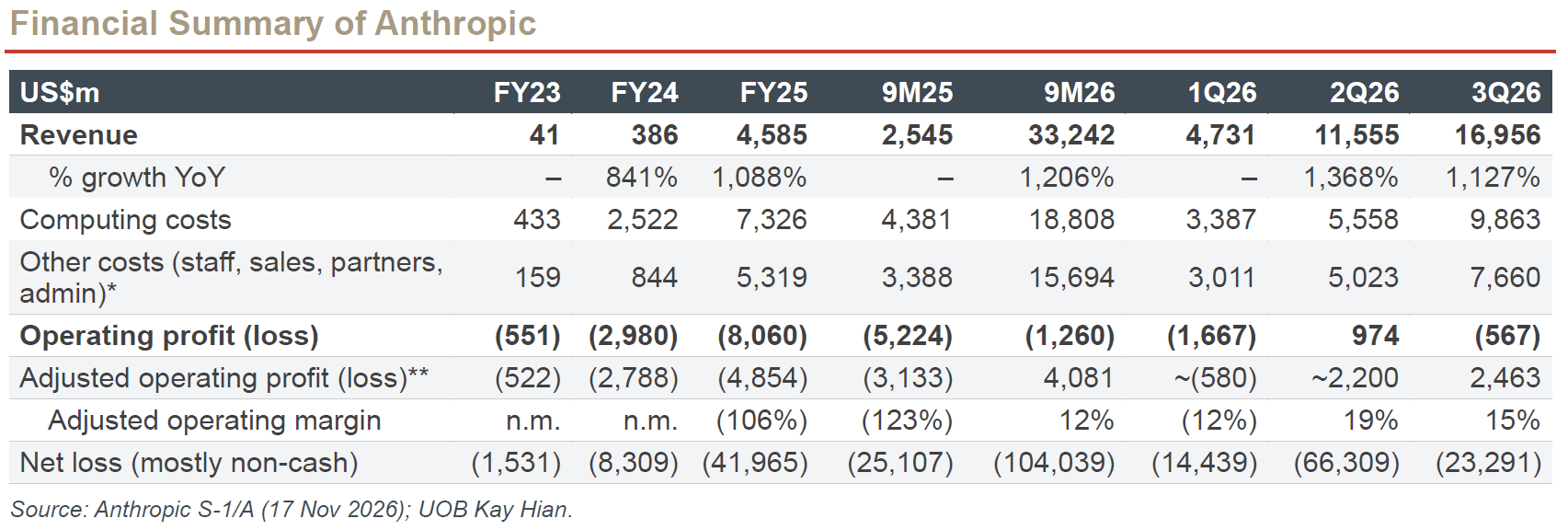
- Revenue growth at scale: Anthropic’s quarterly revenue grew from US$1.4bn to US$17bn in one year. Annual revenue was US$386m in 2024 and US$4.6bn in 2025. In the first nine months of 2026 it reached US$33.2bn, including US$17.0bn in 3Q2026 alone.
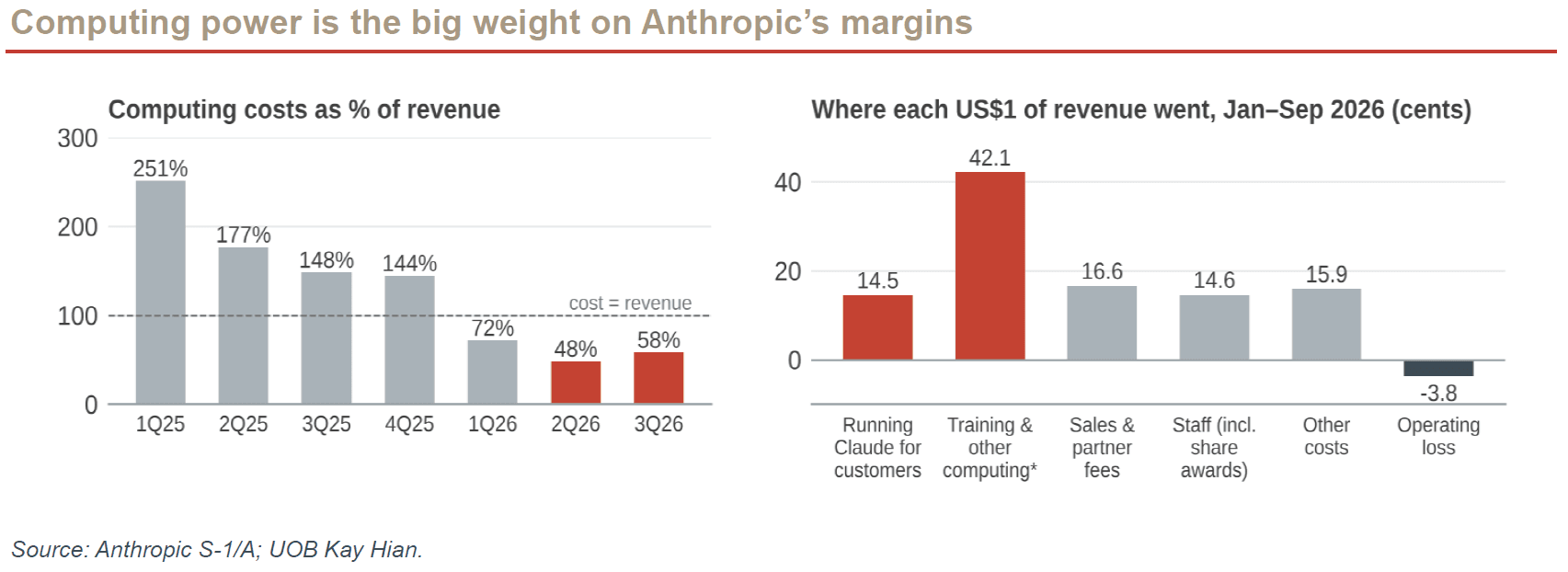
- Computing power is the big weight: Anthropic’s gross margin was 85.5%, or about 69% after sales costs and fees paid to cloud partners. Computing costs rose to 58% of revenue in Q3 from 48% in Q2, as Anthropic paid up for US$5bn of short-term capacity to meet demand. With a one-off US$2bn charity-matching charge, Anthropic’s 3Q2026 swung to a US$567m operating loss, down from a US$974m profit in 2Q2026.
Valuation
What does the US$83 IPO price imply? At US$83 per share, Anthropic is valued at US$1.5tn on a fully diluted basis. After deducting ~US$232bn of cash (including IPO proceeds), Anthropic’s EV (Enterprise Value) is ~US$1.27tn. The stock listed at ~22.2x annualised revenue based on 3Q2026 earnings, ~18.6x annualised revenue based on October’s print.
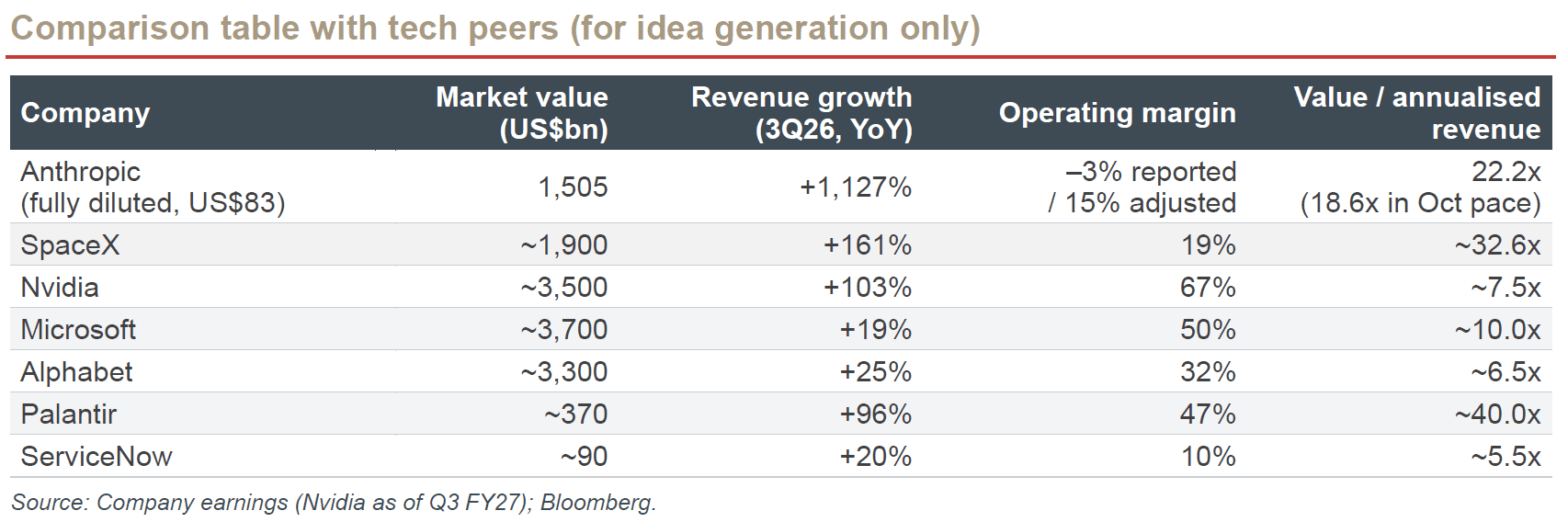
What is priced in? A lot. ANT grows far faster than any of the big tech names in the US (see comparison table below), but its margins are well below big tech’s 30–50%. At ~10x 2027E revenue, it is already valued like big tech.
A simple reverse-DCF shows the scale of the implied delivery. If Anthropic ultimately converts 25% of revenue into free cash flow and the market capitalises that cash flow at 28x, the US$83 price requires roughly US$86bn of 2030 free cash flow — equivalent to ~US$340bn of 2030 revenue, or ~60% annual growth from here (assuming investors require an 11.5% annual return). In short, ANT needs both revenue and margins to deliver.
Key Risks & Mitigations
Risk | Exposure | Mitigations |
Falling product prices | OpenAI’s top model matches Claude’s list price and costs less per task; Google can bundle Gemini; Chinese open models are far cheaper | Lead in coding and complex work; usage has grown much faster than prices have fallen |
Computing bills | Around US$901bn committed, plus an estimated US$150–175bn of variable payments; underwriter expects US$66bn of cash burn in 2027 | The company holds US$232bn cash plus US$77bn of partner credit lines; c.US$186bn of commitments cancellable or conditional; 85% gross margin |
Customer concentration | Top five customers account for c.25% of revenue (Jan–Sep 2026); 44% of revenue sold via cloud partners that also compete | Top-five share fell to ~21% in Q3 from ~36% in Q1; sold on all three major clouds |
Government action | June 2026 worldwide suspension of Fable 5 and Mythos 5 under US export controls | Access restored after 19 days |
Control and share supply | Founders hold 50.1% of votes; ~2% new shares a year; only 7.4% of shares free to trade; staged lock-up expiries | Fully disclosed; Nasdaq-100 index inclusion in late 2026 |
Anthropic, the maker of the Claude family of AI models, listed on Nasdaq on November 19th at US$83 per share. The listing is among the largest technology IPOs on record and has drawn attention due to its position in the global AI race, its rapid revenue growth, and the scale of its future spending commitments. We offer this primer to set out the company's business model, financial profile, competitive position, and the principal issues investors are likely to weigh. For Idea Generation only, not official recommendation.
CIO Summary
- Leading the AI race. Anthropic’s leading model, Claude Fable 5.2, ranks No.1 on the Artificial Analysis Intelligence Index, scoring 65 vs 62 for OpenAI and 61 for Google. On Epoch AI’s index, the US lead over China has widen to roughly six to seven months of progress. Anthropic’s listing underscores the US lead in frontier models amid the US-China AI Race, which remains one of our top predictions for 2027.
- Strong growth profile. Anthropic’s 3Q2026 revenue was US$17bn, more than 12 times the prior year level, and annualised 2026 revenue reached US$81bn in October. Operating cash flow was a positive US$6.6bn in the first nine months of 2026.
- Valuation context. At the US$83 IPO price, Anthropic is valued at US$1.5tn on a fully diluted basis, or ~18.6x annualised revenue by October’s print. ANT is already valued like big tech: it grows far faster than any of the big tech names in the US, but its margins are well below.
What Anthropic does: the company was founded in 2021 by former OpenAI researchers and builds the Claude family of AI models. Businesses use Claude through Anthropic’s own platform, through the cloud services of Amazon, Google and Microsoft, and through apps such as Claude Code, its AI programming assistant. 79% of its revenue is pay-per-use, the rest subscriptions. Anthropic is a PBC (public benefit corporation), which means it is legally required to weigh its safety mission alongside shareholder returns.
Business Highlight
Anthropic’s Claude is the best-rated AI model today. Fable 5.2, launched on 9 Nov, ranks No.1 on the Artificial Analysis Intelligence Index with a score of 65, ahead of OpenAI's GPT-6.2 Astra (62) and Google's new Gemini 4 Neon (61). Note that leadership in model rankings can change quickly.
- Anthropic’s model is the best-rated but not the cheapest: at its highest setting, Fable 5.2 costs about 6.6 times as much as Astra to complete the same test task (US$26.54 vs US$4.00), while taking three times as long. Customers are willing to pay the premium for hard tasks such as complex coding, where cheaper models are good enough for routine tasks.
- Each release is also cheaper to run: Opus 5.5 completes a typical task at roughly 40% lower cost than Opus 5. That supports adoption, but it also means usage must grow faster than prices decline. So far it has.
Companies are building Claude into their daily work
- The biggest share of business spending. Anthropic takes 55% of what US companies spend on AI models, ahead of OpenAI (31%) and Google (9%), according to a Menlo Ventures survey. Payments data from Ramp, covering ~85,000 US businesses, show 44.8% firms paid for Anthropic in October vs 40.6% for OpenAI.
- Hard to replace once it is in. Once Claude is wired into a company’s systems, data permissions and workflows, switching will cost time and money. Claude Code is the product that pulls big customers in, with Anthropic’s top 5% customers spending ~20 times vs. a typical business user.
- Retail is the weak spot. Claude has ~245m monthly consumer users, against more than 1bn each for ChatGPT and Gemini. Cheap open models, led by Chinese labs, already carry about a fifth of business AI usage, though they earn only about 4% of the spending, according to Menlo Ventures.
A shot at the biggest prize in tech: AGI
- AGI (artificial general intelligence) usually means AI that can do most knowledge work at a human level or higher. Nobody knows when, or whether, it will arrive. But there are early signs at Anthropic: Claude wrote over 90% of Anthropic’s new code in September. In its IPO filing, Anthropic says it “may imminently” reach the point where its AI significantly speeds up its own research.
- Why it matters? If AI starts speeding up AI research, the leader could pull further ahead. That justifies some premium for Anthropic. Meanwhile, Anthropic's safety-first structure may create a risk that it moves slower than rivals, a trade-off that investors need to assess.
Other Issues Investors Should Weigh
- Anthropic’s biggest partners are also its suppliers, shareholders and rivals. Amazon (~15%) and Google (~14%) are the largest shareholders. They also sell Claude on their clouds (together with Microsoft), supply much of Anthropic’s computing power while compete with their own models. Seven suppliers, including Google and Nvidia, are buying US$26bn of Anthropic’s IPO shares. In effect, some of the money Anthropic spends with these suppliers comes from the suppliers themselves.
- The co-founders hold 50.1% of the votes through a special share class, and an independent trust elects most of the board. Public shareholders cannot overturn safety-first decisions.
- Watch the share supply/demand. Only ~7.4% of Anthropic’s shares trade freely. Up to ~315m insider shares can be sold from day one and ~1.6bn within 76 days, with a large lock-up expirty around mid-May 2027. On the other side, ANT is expected to join the Nasdaq-100 around late Dec, which could bring index-fund buying.
Financial Profile
- Revenue growth at scale: Anthropic’s quarterly revenue grew from US$1.4bn to US$17bn in one year. Annual revenue was US$386m in 2024 and US$4.6bn in 2025. In the first nine months of 2026 it reached US$33.2bn, including US$17.0bn in 3Q2026 alone.
- Computing power is the big weight: Anthropic’s gross margin was 85.5%, or about 69% after sales costs and fees paid to cloud partners. Computing costs rose to 58% of revenue in Q3 from 48% in Q2, as Anthropic paid up for US$5bn of short-term capacity to meet demand. With a one-off US$2bn charity-matching charge, Anthropic’s 3Q2026 swung to a US$567m operating loss, down from a US$974m profit in 2Q2026.
Valuation
What does the US$83 IPO price imply? At US$83 per share, Anthropic is valued at US$1.5tn on a fully diluted basis. After deducting ~US$232bn of cash (including IPO proceeds), Anthropic’s EV (Enterprise Value) is ~US$1.27tn. The stock listed at ~22.2x annualised revenue based on 3Q2026 earnings, ~18.6x annualised revenue based on October’s print.
What is priced in? A lot. ANT grows far faster than any of the big tech names in the US (see comparison table below), but its margins are well below big tech’s 30–50%. At ~10x 2027E revenue, it is already valued like big tech.
A simple reverse-DCF shows the scale of the implied delivery. If Anthropic ultimately converts 25% of revenue into free cash flow and the market capitalises that cash flow at 28x, the US$83 price requires roughly US$86bn of 2030 free cash flow — equivalent to ~US$340bn of 2030 revenue, or ~60% annual growth from here (assuming investors require an 11.5% annual return). In short, ANT needs both revenue and margins to deliver.
Key Risks & Mitigations
Risk | Exposure | Mitigations |
Falling product prices | OpenAI’s top model matches Claude’s list price and costs less per task; Google can bundle Gemini; Chinese open models are far cheaper | Lead in coding and complex work; usage has grown much faster than prices have fallen |
Computing bills | Around US$901bn committed, plus an estimated US$150–175bn of variable payments; underwriter expects US$66bn of cash burn in 2027 | The company holds US$232bn cash plus US$77bn of partner credit lines; c.US$186bn of commitments cancellable or conditional; 85% gross margin |
Customer concentration | Top five customers account for c.25% of revenue (Jan–Sep 2026); 44% of revenue sold via cloud partners that also compete | Top-five share fell to ~21% in Q3 from ~36% in Q1; sold on all three major clouds |
Government action | June 2026 worldwide suspension of Fable 5 and Mythos 5 under US export controls | Access restored after 19 days |
Control and share supply | Founders hold 50.1% of votes; ~2% new shares a year; only 7.4% of shares free to trade; staged lock-up expiries | Fully disclosed; Nasdaq-100 index inclusion in late 2026 |
Disclosures and disclaimers
This report is provided subject to, and must be read together with, the full Disclosures / Disclaimers available at this link, which are incorporated by reference into this report. In particular, this report is intended for general circulation and informational purposes only and does not constitute personal investment advice or a recommendation to buy or sell any investment product or security. You should independently evaluate the information and, where necessary, seek advice from a qualified financial adviser regarding the suitability of any investment. Analyst certifications required under applicable regulations, including SEC Regulation AC (where relevant), are included in this report. By accessing, receiving or using this report, you acknowledge that you have read, understood and agreed to be bound by the Disclosures / Disclaimers, as may be amended, supplemented or updated from time to time.


