

Periodic/Sector reports
Construction: Unwarranted, Collateral Damage From Nvidia Sequel
OVERWEIGHT (Maintained)
Analyst
Analyst
Highlights
- Concerns on tighter US AI chip regulations due to the Nvidia affairs may de-rail Malaysia’s DC prospects have caused a staggering sector-wide selldown.
- Nevertheless, we assess that the clients of the companies under our coverage are mostly US hyperscalers or non-China-oriented, limiting impacts on AI chips procurement. There are some risks for colocation DC contractors.
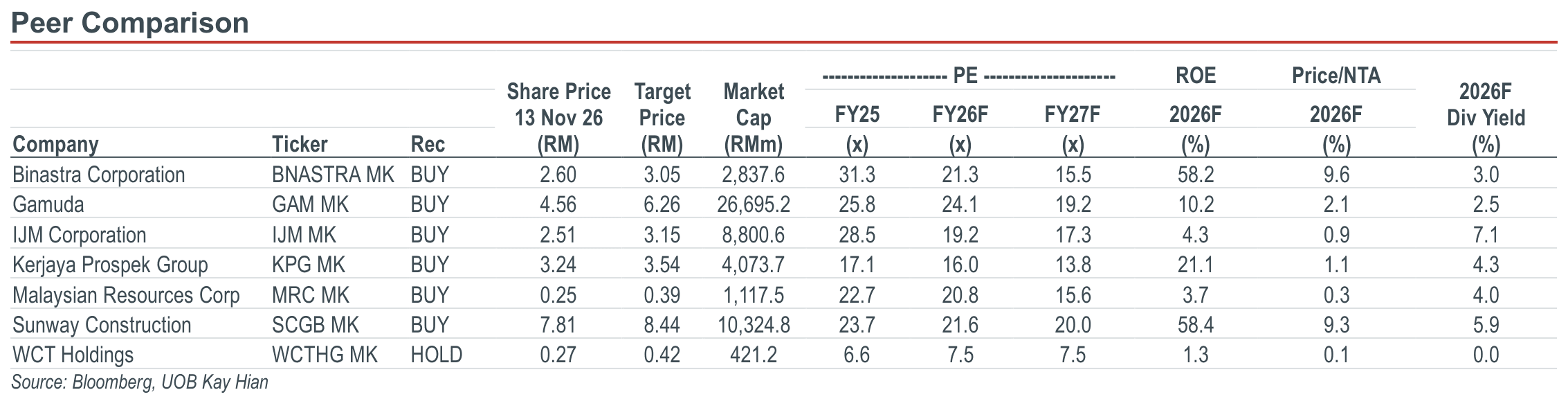
- Maintain OVERWEIGHT on the sector’s record-high orderbook and multi-year earnings visibility. Top picks are Gamuda, IJM, Suncon, Binastra and Kerjaya.
Analysis
- A sector-wide selldown following Nvidia fallout. The KLCON Index marked a 5.1% decline (underperforming FBMKLCI’s -1.8%) since the newsflow of Nvidia CEO Jensen Huang’s affair with an alleged Chinese spy on 29 Oct 26. The affair provoked concerns on tightening regulations and licensing requirements for AI chips and Nvidia graphic processing units (GPU) into Malaysia, which could potentially result in delayed data centre projects’ timeline and investments.
- Tighter AI chip controls may slow down DC progress, but not broad-based... While stricter legislation may be rolled out by the US administration, we deem that the main objectives will be to tighten control for China-linked entities from accessing Nvidia’s AI chips, besides avoiding transshipment from neighbouring countries like Malaysia into China. Meanwhile, US-based DC hyperscalers which are asset owners and are not operating colocation DCs in Malaysia will likely have uninterrupted access to AI chips.
- …with limited primary impact towards most domestic contractors under our coverage, except colocation DC contractors. The DC contractors under our coverage are mainly involved in the designing, construction and infrastructure stages for US hyperscalers and non-China entities (not operators or owning assets). Hence, the viability of their DC pipeline likely remains intact. That said, we do not rule potential slowdown for colocation-oriented DCs with China-related offtakers, if the tightening AI chip controls delay chip procurements, financing, or impact demand and capacity.
- Drawing parallels to the earlier AI diffusion framework introduced in Jan 25, which was then rescinded in May 25. To recall, Malaysia was classified as a Tier 2 country under the AI diffusion framework and chip exports restriction introduced by former US President Joe Biden’s administration. Under that proposal, Malaysia will be permitted to import only 50,000 GPUs over two years, while DC operators can only deploy a maximum of 7% of their computing capacity in the nation. There are no cancellations or scale-backs of major DC projects related to US hyperscalers during this period as their procurement of AI chips were largely uninterrupted.
Highlights
- Concerns on tighter US AI chip regulations due to the Nvidia affairs may de-rail Malaysia’s DC prospects have caused a staggering sector-wide selldown.
- Nevertheless, we assess that the clients of the companies under our coverage are mostly US hyperscalers or non-China-oriented, limiting impacts on AI chips procurement. There are some risks for colocation DC contractors.
- Maintain OVERWEIGHT on the sector’s record-high orderbook and multi-year earnings visibility. Top picks are Gamuda, IJM, Suncon, Binastra and Kerjaya.
Analysis
- A sector-wide selldown following Nvidia fallout. The KLCON Index marked a 5.1% decline (underperforming FBMKLCI’s -1.8%) since the newsflow of Nvidia CEO Jensen Huang’s affair with an alleged Chinese spy on 29 Oct 26. The affair provoked concerns on tightening regulations and licensing requirements for AI chips and Nvidia graphic processing units (GPU) into Malaysia, which could potentially result in delayed data centre projects’ timeline and investments.
- Tighter AI chip controls may slow down DC progress, but not broad-based... While stricter legislation may be rolled out by the US administration, we deem that the main objectives will be to tighten control for China-linked entities from accessing Nvidia’s AI chips, besides avoiding transshipment from neighbouring countries like Malaysia into China. Meanwhile, US-based DC hyperscalers which are asset owners and are not operating colocation DCs in Malaysia will likely have uninterrupted access to AI chips.
- …with limited primary impact towards most domestic contractors under our coverage, except colocation DC contractors. The DC contractors under our coverage are mainly involved in the designing, construction and infrastructure stages for US hyperscalers and non-China entities (not operators or owning assets). Hence, the viability of their DC pipeline likely remains intact. That said, we do not rule potential slowdown for colocation-oriented DCs with China-related offtakers, if the tightening AI chip controls delay chip procurements, financing, or impact demand and capacity.
- Drawing parallels to the earlier AI diffusion framework introduced in Jan 25, which was then rescinded in May 25. To recall, Malaysia was classified as a Tier 2 country under the AI diffusion framework and chip exports restriction introduced by former US President Joe Biden’s administration. Under that proposal, Malaysia will be permitted to import only 50,000 GPUs over two years, while DC operators can only deploy a maximum of 7% of their computing capacity in the nation. There are no cancellations or scale-backs of major DC projects related to US hyperscalers during this period as their procurement of AI chips were largely uninterrupted.
OVERWEIGHT (Maintained)
Analyst
Analyst
IMPORTANT NOTICE - DISCLOSURES AND DISCLAIMERS
This report is provided subject to, and must be read together with, the full Disclosures / Disclaimers available at this link, which are incorporated by reference into this report. In particular, this report is intended for general circulation and informational purposes only and does not constitute personal investment advice or a recommendation to buy or sell any investment product or security. You should independently evaluate the information and, where necessary, seek advice from a qualified financial adviser regarding the suitability of any investment. Analyst certifications required under applicable regulations, including SEC Regulation AC (where relevant), are included in this report. By accessing, receiving or using this report, you acknowledge that you have read, understood and agreed to be bound by the Disclosures / Disclaimers, as may be amended, supplemented or updated from time to time.
Related articles

14 Oct 2026
Construction: Budget 2027 Neutral; Marginal Lift From Expansionary Stance

3 Nov 2026
Renewable Energy: Tailwind From Positive Regulatory Framework; Record Orderbook Wins

23 Sept 2026

