

Wealth Daily
Korean Chip Stocks Tumble on China Competition
Today’s Must-Know News
Overnight Markets
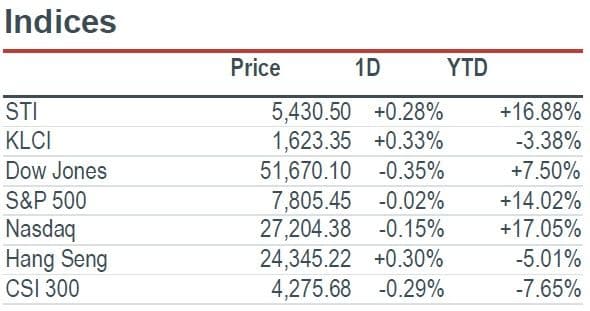
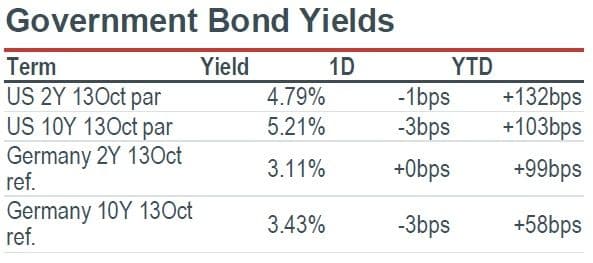
Market Movers: The S&P 500 slipped 0.02% in the Tuesday, 13 October US session, following a sharp Asian chip selloff. SK Hynix (000660 KS) fell 10.09% and Samsung Electronics (005930 KS) lost 7.39% as reports of Chinese rival CXMT’s progress in server memory raised competition concerns. The KOSPI fell 5.46%. The reported advance involves server memory, rather than high-bandwidth memory, where Korean producers retain an edge; production scale and yields remain key uncertainties. Nvidia (NVDA US) gained 0.97% despite a separate IDC report showing first-half China AI-accelerator shipments fell 44% YoY to 678,000, with a 34% market share. Huawei’s share reached 28%. (Reuters / Reuters / FactSet)
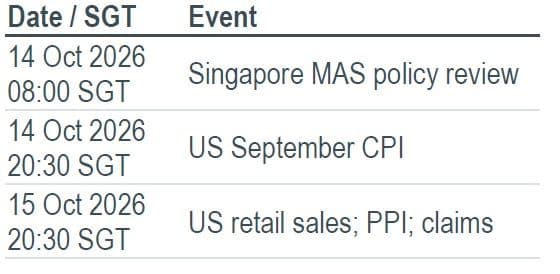
Macro: The IMF raised its 2026 global growth forecast to 3.1% from July’s 3.0%, while warning that war, debt and energy costs threaten an outlook supported by AI investment. That remains below 2025’s 3.5%. Singapore’s MAS policy review is due at 08:00 SGT today. All ten economists in Reuters’ earlier poll expected tightening. Watch the currency-band slope and inflation guidance: a steeper slope would support the Singapore dollar, while an unchanged stance could disappoint that expectation. (Reuters / Reuters / MAS)
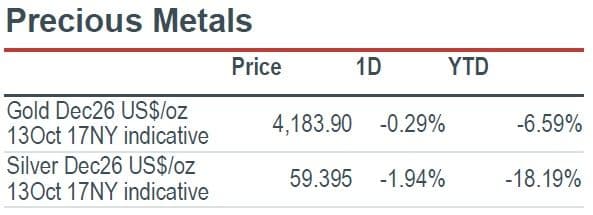
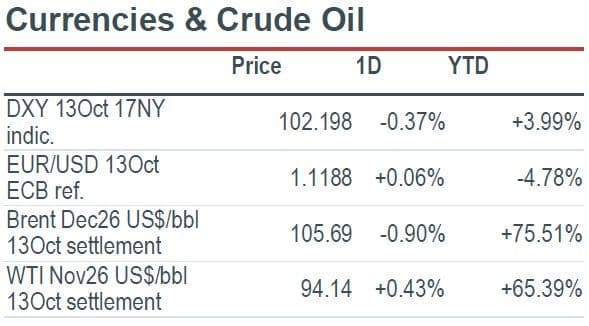
FICC: December Brent settled down 0.90% at US$105.69/bbl; November WTI rose 0.43% to US$94.14 on 13 October. Prospective Russian diesel supply offset Saudi-Yemen supply risks, while OPEC cut its 2026 demand-growth forecast for a sixth consecutive month. December silver fell 1.94% to US$59.395/oz at the matched 17:00 New York indicative snapshot; this is not an exchange settlement. (Reuters / Yahoo Finance) Nvidia (NVDA US) is our Core Recommendation.
AI
- Nvidia (NVDA US) loses ground in China. IDC’s first-half data, newly reported on 13 October, show 678,000 China AI-accelerator shipments, down 44% YoY, and 34% market share; Huawei held 28%. Export restrictions and domestic substitution threaten access to a growing compute market, although product mix was undisclosed. Shares nevertheless closed 13 October up 0.97% at US$228.52. (Reuters / Stock Analysis)
Nvidia (NVDA US) is our Core Recommendation.
- Apple (AAPL US) takes Siri AI into the connected home. The US$299 HomeView display combines a seven-inch screen with facial recognition and personalised Siri responses, with availability from 13 November. It will not be sold in the EU because Siri AI remains unavailable there. The launch extends Apple’s device-and-services opportunity, but ecosystem compatibility, geographic restrictions and consumer adoption will determine its contribution. (Apple)
- Banking supervisors intensify scrutiny of autonomous AI. Reuters disclosed fresh inquiries by three US regulators—the Fed, OCC and FDIC—into banks’ agent controls, Chinese models and audit trails. European supervisors are pressing for stronger recovery systems. The US exercise remains information-gathering rather than a new prescriptive rule, but cyber-recovery and governance spending could offset some savings from greater automation. (Reuters)
- Micron Technology (MU US) faces renewed memory competition concerns. Shares closed 13 October at US$953.19, down 3.62%, as memory stocks retreated. Reuters linked the weakness to reports of CXMT progress on denser memory-cell architecture and AI-spending concerns. The milestone does not establish commercial parity; production scaling and customer qualification remain more decisive tests of competition and the potential earnings impact. (Reuters / Stock Analysis)
Micron Technology (MU US) is our Trading Buy.
Americas
- Johnson & Johnson (JNJ US) raises guidance despite reported-profit weakness. Third-quarter sales rose 5.9% YoY to US$25.4bn, while adjusted EPS fell 7.5% to US$2.59. Reported EPS was US$0.09 after talc and deal charges. Full-year adjusted EPS guidance increased to US$11.10 at midpoint from US$11.04. Shares closed 13 October down 5.73% at US$248.61, highlighting the contrast between operating delivery and legal costs. (J&J / Stock Analysis)
Johnson & Johnson (JNJ US) is our Core Recommendation.
- JPMorgan Chase (JPM US) misses profit expectations. Third-quarter EPS of US$5.57 missed the US$5.85 LSEG consensus. Investment-banking fees rose 14% YoY but fell 8% sequentially; fixed-income trading declined 4% YoY. Net interest income excluding markets grew 6% to US$24.7bn. Shares closed 13 October down 0.86% at US$331.43. Lending resilience cushions weaker dealmaking, but sustained fee momentum remains uncertain. (Reuters / Stock Analysis)
- Citigroup (C US) benefits from a favourable earnings comparison. Third-quarter revenue grew 8% YoY to US$23.8bn and net income rose 40% to US$5.2bn, helped by a US$714m after-tax goodwill charge a year earlier. Capital returns totalled US$4.1bn. Shares closed 13 October down 5.60% at US$124.53. The comparison benefit means investors should distinguish recurring revenue progress from reported profit growth. (Citi / Stock Analysis)
- Wells Fargo (WFC US) faces higher credit costs. Third-quarter EPS increased 13% YoY to US$1.87 and revenue grew 2% to US$21.87bn. Net interest income rose 5% to US$12.52bn, while credit-loss provisions climbed 51% to US$1.03bn. Shares closed 13 October down 3.10% at US$80.74. Loan growth supports interest revenue, but returns depend on keeping incremental credit costs contained. (Wells Fargo / Stock Analysis)
- Goldman Sachs (GS US) shows sequential trading weakness. Third-quarter revenue grew 23% YoY to US$18.68bn. Equities revenue reached US$6.44bn, up 72% YoY but down 13% sequentially; investment-banking fees rose 21% YoY but fell 5% sequentially. Shares closed 13 October down 0.23% at US$891.91. Strong annual comparisons therefore warrant caution when extrapolating recent trading conditions into future earnings. (Goldman Sachs / Stock Analysis)
- UnitedHealth Group (UNH US) raises its outlook. Third-quarter revenue slipped about 0.4% YoY to US$112.7bn, while the medical-care ratio improved to 88.4% from 89.9%. Full-year adjusted EPS guidance rose to at least US$20.50. Shares closed 13 October down 0.20% at US$377.76. However, US$610m of favourable reserve development supported results; sustaining the recovery requires underlying pricing and care-management gains. (UnitedHealth / Stock Analysis)
- Boeing (BA US) deliveries show little annual growth. Preliminary third-quarter commercial deliveries totalled 161 aircraft versus 160 a year earlier, up 0.6%, including 124 737s and 22 787s. Deliveries become final with quarterly results. Shares closed 13 October down 1.59% at US$186.49. Aircraft handovers provide an execution indicator, but do not establish cash conversion or margins on the delivered aircraft. (Boeing / Stock Analysis / Boeing 2025)
Greater China
- Tencent secures funding despite AI scrutiny. Tencent (0700.HK) raised about US$5.7bn in dollar and offshore-yuan bonds on 13 October, attracting over US$23bn of orders, Reuters reported. Dollar spreads tightened 25bps from initial guidance; yuan yields tightened 50bps. Demand supports financing flexibility, although proceeds are for general corporate purposes and debt demand does not establish eventual AI investment returns. (Reuters)
Tencent (0700.HK) is our Core Recommendation.
- Alibaba expands its AI hardware entry points. Alibaba (9988.HK) unveiled Qwen Glasses N1 on 13 October, starting at RMB2,999 before discounts. The RMB3,499 Pro adds eye tracking; shopping and payment functions integrate with its AI assistant. RMB1,299 Qwen Clip earbuds were developed with Bose. The hardware broadens Qwen’s reach, but monetisation depends on sustained usage and product economics, rather than specifications alone. (Bloomberg)
Alibaba (9988.HK) is our Core Recommendation.
- Visa advances toward domestic China clearing. Visa (V US) said on 13 October that China’s central bank approved its application to prepare a domestic bankcard clearing institution. The regulatory process must still be completed before domestic operations begin. The decision opens a potential growth avenue, but operating readiness, partnerships and adoption remain key; preparatory approval should not be treated as immediate revenue. (Visa)
- Hong Kong preserves assets in IPO probe. The SFC suspended Sichuan Baicha Baidao (2555.HK) from 09:00 SGT on 13 October over suspected artificial IPO demand. Restrictions on two suspected syndicates cover up to HK$4.66bn of assets; recipient brokers are not investigation targets. Allocation integrity and disclosure merit scrutiny, while investors should distinguish unproven allegations and restricted client assets from brokers’ financial condition. (SFC)
Asia ex. China
- Memory competition fears hit Korean leaders. At Korea’s 13 October close, Samsung Electronics (005930 KS) fell 7.39% to KRW232,000 and SK Hynix (000660 KS) lost 10.09% to KRW1,443,000. Reuters linked the selloff to reported CXMT server-memory progress and AI valuation concerns; the development was not in high-bandwidth memory. Manufacturing yields and scale remain crucial to assessing eventual competitive displacement. (Reuters / Market data / Market data)
- HCLTech earnings rebound wins a rerating. HCLTech (HCLTECH.NS) closed 13 October at INR1,326.00, up 8.42%, following the previous day’s results. September-quarter revenue rose 11.5% YoY to INR356.2bn and net income increased 21.2% to INR51.32bn; annual constant-currency revenue guidance is 2.5–4.0% growth. The profit recovery contrasts with hardware’s selloff, but modest underlying growth leaves execution central to sustaining margins. (HCLTech / Market data)
- AirTrunk reportedly postpones Singapore IPO. AirTrunk postponed a Singapore REIT IPO intended to raise about US$1.5bn, Reuters reported on 13 October, citing sources. Launch timing is undecided; a source cited an early-2027 completion target. Blackstone declined comment and AirTrunk did not immediately respond. The reported delay tests data-centre financing appetite as investors reassess AI valuations, borrowing costs and demand durability. (Reuters)
EMEA and Others
- Refining supports BP, with impairment drag. BP (BP.L) reported a third-quarter refining-margin indicator of US$46.70/barrel on 13 October, versus US$29.60 the preceding quarter and US$15.80 a year earlier. Refining should add US$1.9–2.1bn to products earnings quarter-on-quarter, alongside US$3–4.5bn of impairments. Stronger downstream cash generation must be distinguished from gas and low-carbon asset-value reductions when assessing the durability of the recovery. (Reuters)
- Roche adds a differentiated obesity option. Roche (ROP.SW) licensed Rona’s experimental ALK7-targeting RNAi obesity therapy worldwide on 13 October. Payments include up to US$100m upfront and in near-term milestones, plus up to US$1.06bn in further milestones and sales royalties. Targeting fat tissue could complement existing mechanisms, but efficacy and safety need demonstration; the headline value is largely contingent, rather than immediate cash. (Rona Therapeutics)
- Nokia refocuses through campus-edge disposal. Nokia (NOKIA.HE) agreed on 13 October to sell Enterprise Campus Edge to AURELIUS for undisclosed terms. The business serves nearly 900 customers in private wireless, industrial devices and edge software; completion is expected in first-half 2027, subject to approvals and customary conditions. The sale narrows Nokia’s portfolio, but the valuation and resulting cash benefit remain unquantified. (Nokia)
- Publicis sustains growth and annual targets. Publicis (PUB.PA) reported third-quarter net revenue of EUR3.808bn on 13 October, up 7.9% YoY and 5.0% organically. It reaffirmed annual organic growth of 4.5–5.0% and an operating margin slightly above 18.2%; technology still contracted globally despite sequential improvement. Client wins support advertising resilience, while a broader technology recovery would strengthen growth durability beyond the current quarter. (Publicis)
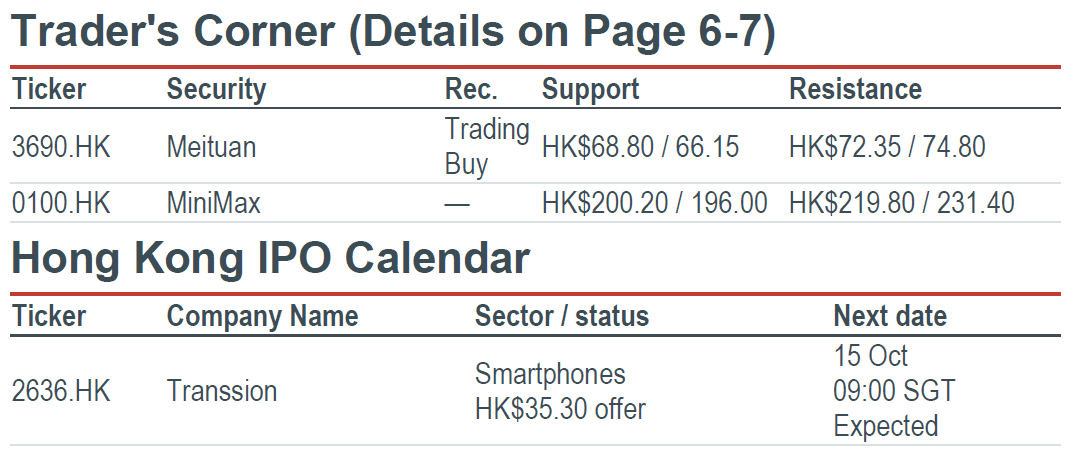
Traders' Corner
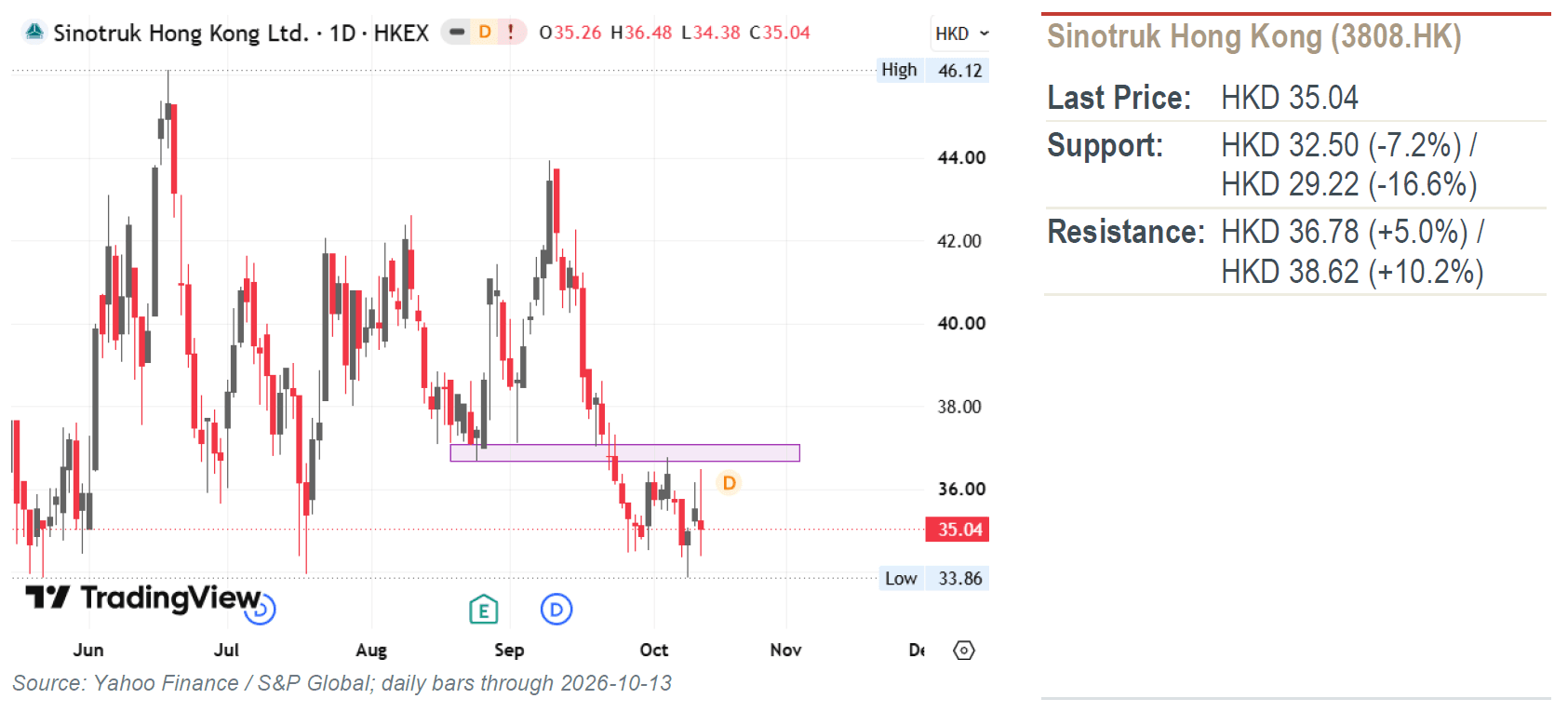
Our Technical View
- Price was capped by its support-turned-resistance zone.
- It could be forming a classic bear flag continuation pattern.
- The RSI remains below its neutral 50-midline, reflecting persistent downside momentum velocity.
- As long as price remains underneath this retested resistance anchor and flag upper channel bound, we see a bearish flag breakdown toward lower support.
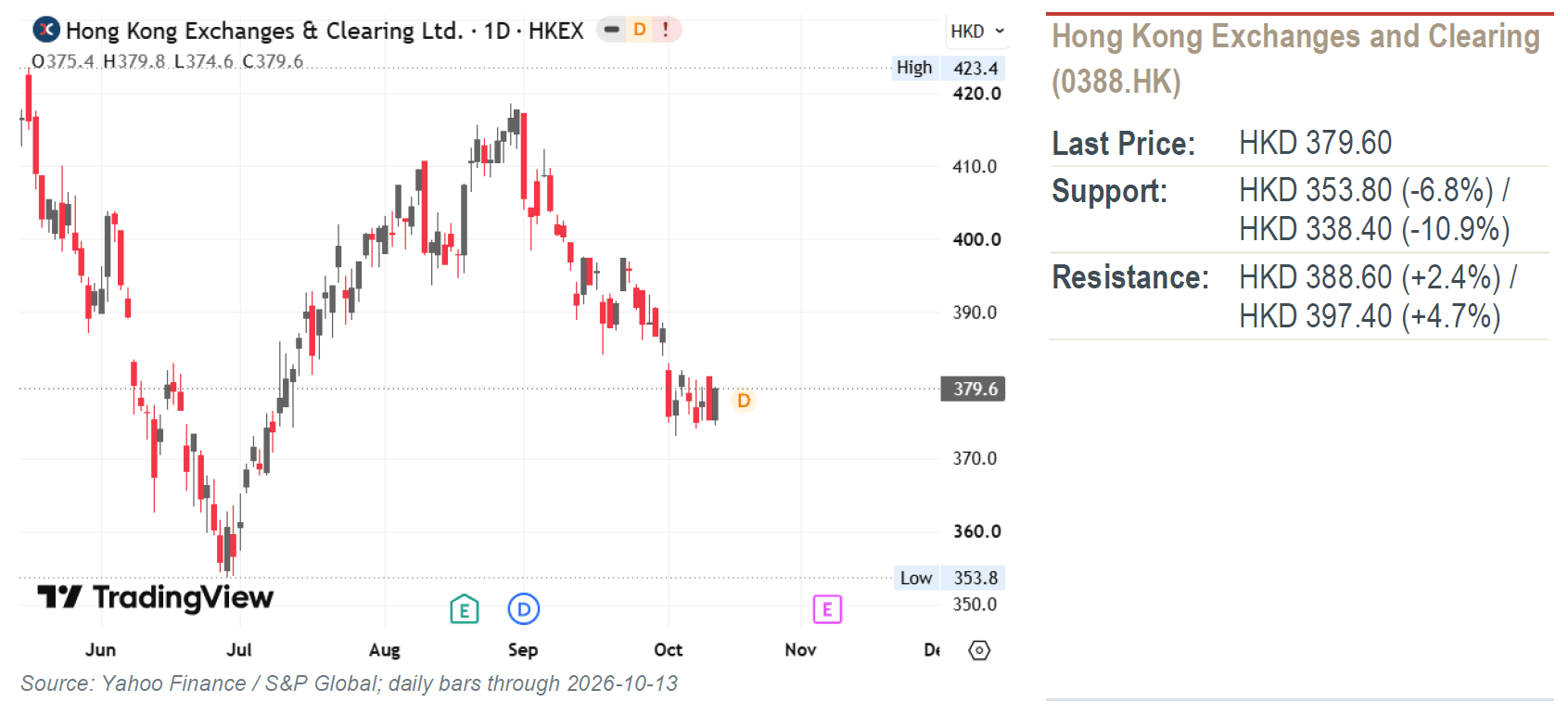
Our Technical View
- Price is currently consolidating within a bear flag pattern, representing a brief counter-trend pause following a prior downward mark-down leg.
- The RSI remains below its neutral 50-midline, confirming an ongoing sell-side impulse.
- A decisive structural breach below the flag pattern’s lower boundary will validate flag completion, triggering an immediate trend acceleration and initiating another high-velocity downward expansion toward downside support.
Market Movers: The S&P 500 slipped 0.02% in the Tuesday, 13 October US session, following a sharp Asian chip selloff. SK Hynix (000660 KS) fell 10.09% and Samsung Electronics (005930 KS) lost 7.39% as reports of Chinese rival CXMT’s progress in server memory raised competition concerns. The KOSPI fell 5.46%. The reported advance involves server memory, rather than high-bandwidth memory, where Korean producers retain an edge; production scale and yields remain key uncertainties. Nvidia (NVDA US) gained 0.97% despite a separate IDC report showing first-half China AI-accelerator shipments fell 44% YoY to 678,000, with a 34% market share. Huawei’s share reached 28%. (Reuters / Reuters / FactSet)
Macro: The IMF raised its 2026 global growth forecast to 3.1% from July’s 3.0%, while warning that war, debt and energy costs threaten an outlook supported by AI investment. That remains below 2025’s 3.5%. Singapore’s MAS policy review is due at 08:00 SGT today. All ten economists in Reuters’ earlier poll expected tightening. Watch the currency-band slope and inflation guidance: a steeper slope would support the Singapore dollar, while an unchanged stance could disappoint that expectation. (Reuters / Reuters / MAS)
FICC: December Brent settled down 0.90% at US$105.69/bbl; November WTI rose 0.43% to US$94.14 on 13 October. Prospective Russian diesel supply offset Saudi-Yemen supply risks, while OPEC cut its 2026 demand-growth forecast for a sixth consecutive month. December silver fell 1.94% to US$59.395/oz at the matched 17:00 New York indicative snapshot; this is not an exchange settlement. (Reuters / Yahoo Finance) Nvidia (NVDA US) is our Core Recommendation.
AI
- Nvidia (NVDA US) loses ground in China. IDC’s first-half data, newly reported on 13 October, show 678,000 China AI-accelerator shipments, down 44% YoY, and 34% market share; Huawei held 28%. Export restrictions and domestic substitution threaten access to a growing compute market, although product mix was undisclosed. Shares nevertheless closed 13 October up 0.97% at US$228.52. (Reuters / Stock Analysis)
Nvidia (NVDA US) is our Core Recommendation.
- Apple (AAPL US) takes Siri AI into the connected home. The US$299 HomeView display combines a seven-inch screen with facial recognition and personalised Siri responses, with availability from 13 November. It will not be sold in the EU because Siri AI remains unavailable there. The launch extends Apple’s device-and-services opportunity, but ecosystem compatibility, geographic restrictions and consumer adoption will determine its contribution. (Apple)
- Banking supervisors intensify scrutiny of autonomous AI. Reuters disclosed fresh inquiries by three US regulators—the Fed, OCC and FDIC—into banks’ agent controls, Chinese models and audit trails. European supervisors are pressing for stronger recovery systems. The US exercise remains information-gathering rather than a new prescriptive rule, but cyber-recovery and governance spending could offset some savings from greater automation. (Reuters)
- Micron Technology (MU US) faces renewed memory competition concerns. Shares closed 13 October at US$953.19, down 3.62%, as memory stocks retreated. Reuters linked the weakness to reports of CXMT progress on denser memory-cell architecture and AI-spending concerns. The milestone does not establish commercial parity; production scaling and customer qualification remain more decisive tests of competition and the potential earnings impact. (Reuters / Stock Analysis)
Micron Technology (MU US) is our Trading Buy.
Americas
- Johnson & Johnson (JNJ US) raises guidance despite reported-profit weakness. Third-quarter sales rose 5.9% YoY to US$25.4bn, while adjusted EPS fell 7.5% to US$2.59. Reported EPS was US$0.09 after talc and deal charges. Full-year adjusted EPS guidance increased to US$11.10 at midpoint from US$11.04. Shares closed 13 October down 5.73% at US$248.61, highlighting the contrast between operating delivery and legal costs. (J&J / Stock Analysis)
Johnson & Johnson (JNJ US) is our Core Recommendation.
- JPMorgan Chase (JPM US) misses profit expectations. Third-quarter EPS of US$5.57 missed the US$5.85 LSEG consensus. Investment-banking fees rose 14% YoY but fell 8% sequentially; fixed-income trading declined 4% YoY. Net interest income excluding markets grew 6% to US$24.7bn. Shares closed 13 October down 0.86% at US$331.43. Lending resilience cushions weaker dealmaking, but sustained fee momentum remains uncertain. (Reuters / Stock Analysis)
- Citigroup (C US) benefits from a favourable earnings comparison. Third-quarter revenue grew 8% YoY to US$23.8bn and net income rose 40% to US$5.2bn, helped by a US$714m after-tax goodwill charge a year earlier. Capital returns totalled US$4.1bn. Shares closed 13 October down 5.60% at US$124.53. The comparison benefit means investors should distinguish recurring revenue progress from reported profit growth. (Citi / Stock Analysis)
- Wells Fargo (WFC US) faces higher credit costs. Third-quarter EPS increased 13% YoY to US$1.87 and revenue grew 2% to US$21.87bn. Net interest income rose 5% to US$12.52bn, while credit-loss provisions climbed 51% to US$1.03bn. Shares closed 13 October down 3.10% at US$80.74. Loan growth supports interest revenue, but returns depend on keeping incremental credit costs contained. (Wells Fargo / Stock Analysis)
- Goldman Sachs (GS US) shows sequential trading weakness. Third-quarter revenue grew 23% YoY to US$18.68bn. Equities revenue reached US$6.44bn, up 72% YoY but down 13% sequentially; investment-banking fees rose 21% YoY but fell 5% sequentially. Shares closed 13 October down 0.23% at US$891.91. Strong annual comparisons therefore warrant caution when extrapolating recent trading conditions into future earnings. (Goldman Sachs / Stock Analysis)
- UnitedHealth Group (UNH US) raises its outlook. Third-quarter revenue slipped about 0.4% YoY to US$112.7bn, while the medical-care ratio improved to 88.4% from 89.9%. Full-year adjusted EPS guidance rose to at least US$20.50. Shares closed 13 October down 0.20% at US$377.76. However, US$610m of favourable reserve development supported results; sustaining the recovery requires underlying pricing and care-management gains. (UnitedHealth / Stock Analysis)
- Boeing (BA US) deliveries show little annual growth. Preliminary third-quarter commercial deliveries totalled 161 aircraft versus 160 a year earlier, up 0.6%, including 124 737s and 22 787s. Deliveries become final with quarterly results. Shares closed 13 October down 1.59% at US$186.49. Aircraft handovers provide an execution indicator, but do not establish cash conversion or margins on the delivered aircraft. (Boeing / Stock Analysis / Boeing 2025)
Greater China
- Tencent secures funding despite AI scrutiny. Tencent (0700.HK) raised about US$5.7bn in dollar and offshore-yuan bonds on 13 October, attracting over US$23bn of orders, Reuters reported. Dollar spreads tightened 25bps from initial guidance; yuan yields tightened 50bps. Demand supports financing flexibility, although proceeds are for general corporate purposes and debt demand does not establish eventual AI investment returns. (Reuters)
Tencent (0700.HK) is our Core Recommendation.
- Alibaba expands its AI hardware entry points. Alibaba (9988.HK) unveiled Qwen Glasses N1 on 13 October, starting at RMB2,999 before discounts. The RMB3,499 Pro adds eye tracking; shopping and payment functions integrate with its AI assistant. RMB1,299 Qwen Clip earbuds were developed with Bose. The hardware broadens Qwen’s reach, but monetisation depends on sustained usage and product economics, rather than specifications alone. (Bloomberg)
Alibaba (9988.HK) is our Core Recommendation.
- Visa advances toward domestic China clearing. Visa (V US) said on 13 October that China’s central bank approved its application to prepare a domestic bankcard clearing institution. The regulatory process must still be completed before domestic operations begin. The decision opens a potential growth avenue, but operating readiness, partnerships and adoption remain key; preparatory approval should not be treated as immediate revenue. (Visa)
- Hong Kong preserves assets in IPO probe. The SFC suspended Sichuan Baicha Baidao (2555.HK) from 09:00 SGT on 13 October over suspected artificial IPO demand. Restrictions on two suspected syndicates cover up to HK$4.66bn of assets; recipient brokers are not investigation targets. Allocation integrity and disclosure merit scrutiny, while investors should distinguish unproven allegations and restricted client assets from brokers’ financial condition. (SFC)
Asia ex. China
- Memory competition fears hit Korean leaders. At Korea’s 13 October close, Samsung Electronics (005930 KS) fell 7.39% to KRW232,000 and SK Hynix (000660 KS) lost 10.09% to KRW1,443,000. Reuters linked the selloff to reported CXMT server-memory progress and AI valuation concerns; the development was not in high-bandwidth memory. Manufacturing yields and scale remain crucial to assessing eventual competitive displacement. (Reuters / Market data / Market data)
- HCLTech earnings rebound wins a rerating. HCLTech (HCLTECH.NS) closed 13 October at INR1,326.00, up 8.42%, following the previous day’s results. September-quarter revenue rose 11.5% YoY to INR356.2bn and net income increased 21.2% to INR51.32bn; annual constant-currency revenue guidance is 2.5–4.0% growth. The profit recovery contrasts with hardware’s selloff, but modest underlying growth leaves execution central to sustaining margins. (HCLTech / Market data)
- AirTrunk reportedly postpones Singapore IPO. AirTrunk postponed a Singapore REIT IPO intended to raise about US$1.5bn, Reuters reported on 13 October, citing sources. Launch timing is undecided; a source cited an early-2027 completion target. Blackstone declined comment and AirTrunk did not immediately respond. The reported delay tests data-centre financing appetite as investors reassess AI valuations, borrowing costs and demand durability. (Reuters)
EMEA and Others
- Refining supports BP, with impairment drag. BP (BP.L) reported a third-quarter refining-margin indicator of US$46.70/barrel on 13 October, versus US$29.60 the preceding quarter and US$15.80 a year earlier. Refining should add US$1.9–2.1bn to products earnings quarter-on-quarter, alongside US$3–4.5bn of impairments. Stronger downstream cash generation must be distinguished from gas and low-carbon asset-value reductions when assessing the durability of the recovery. (Reuters)
- Roche adds a differentiated obesity option. Roche (ROP.SW) licensed Rona’s experimental ALK7-targeting RNAi obesity therapy worldwide on 13 October. Payments include up to US$100m upfront and in near-term milestones, plus up to US$1.06bn in further milestones and sales royalties. Targeting fat tissue could complement existing mechanisms, but efficacy and safety need demonstration; the headline value is largely contingent, rather than immediate cash. (Rona Therapeutics)
- Nokia refocuses through campus-edge disposal. Nokia (NOKIA.HE) agreed on 13 October to sell Enterprise Campus Edge to AURELIUS for undisclosed terms. The business serves nearly 900 customers in private wireless, industrial devices and edge software; completion is expected in first-half 2027, subject to approvals and customary conditions. The sale narrows Nokia’s portfolio, but the valuation and resulting cash benefit remain unquantified. (Nokia)
- Publicis sustains growth and annual targets. Publicis (PUB.PA) reported third-quarter net revenue of EUR3.808bn on 13 October, up 7.9% YoY and 5.0% organically. It reaffirmed annual organic growth of 4.5–5.0% and an operating margin slightly above 18.2%; technology still contracted globally despite sequential improvement. Client wins support advertising resilience, while a broader technology recovery would strengthen growth durability beyond the current quarter. (Publicis)
Traders' Corner
Our Technical View
- Price was capped by its support-turned-resistance zone.
- It could be forming a classic bear flag continuation pattern.
- The RSI remains below its neutral 50-midline, reflecting persistent downside momentum velocity.
- As long as price remains underneath this retested resistance anchor and flag upper channel bound, we see a bearish flag breakdown toward lower support.
Our Technical View
- Price is currently consolidating within a bear flag pattern, representing a brief counter-trend pause following a prior downward mark-down leg.
- The RSI remains below its neutral 50-midline, confirming an ongoing sell-side impulse.
- A decisive structural breach below the flag pattern’s lower boundary will validate flag completion, triggering an immediate trend acceleration and initiating another high-velocity downward expansion toward downside support.
Disclosures and disclaimers
This report is provided subject to, and must be read together with, the full Disclosures / Disclaimers available at this link, which are incorporated by reference into this report. In particular, this report is intended for general circulation and informational purposes only and does not constitute personal investment advice or a recommendation to buy or sell any investment product or security. You should independently evaluate the information and, where necessary, seek advice from a qualified financial adviser regarding the suitability of any investment. Analyst certifications required under applicable regulations, including SEC Regulation AC (where relevant), are included in this report. By accessing, receiving or using this report, you acknowledge that you have read, understood and agreed to be bound by the Disclosures / Disclaimers, as may be amended, supplemented or updated from time to time.


