

Periodic/Sector reports
Consumer: Budget 2027 Deep-Dive: Pro-Rakyat, Selectively Positive For Equities
Highlights
- The measures announced during Budget 2027 were expectedly consumer-friendly with higher cash handouts and increased tax reliefs, especially for the middle-income bracket.
- The minimum wage increase to RM2,000 is expected to hit selective labour-reliant names (ie retailers), but broader wage hikes across the GLCs and skilled and semi-skilled jobs could lift sentiment as spending power grows.
- Maintain MARKET WEIGHT. Despite the broad-based support for consumers, we remain selectively positive on the sector as soft sentiment and other external headwinds persist.
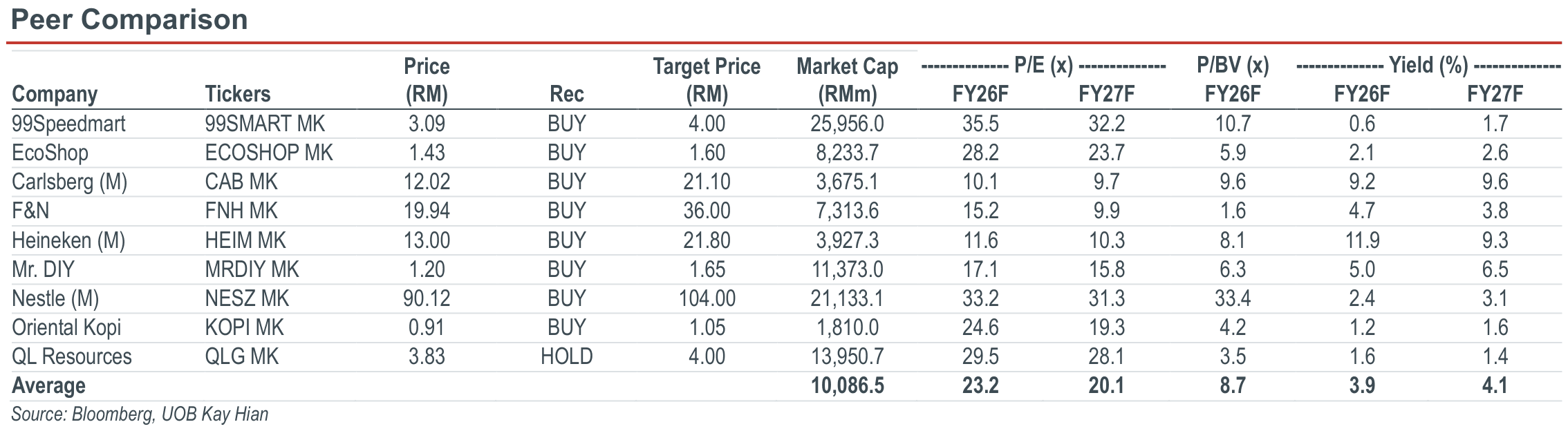
- Top picks for Budget beneficiaries: 99 Speedmart and Oriental Kopi. We upgrade Oriental Kopi to BUY from HOLD following the recent share price weakness.
Analysis
- Spending power to the people. Budget 2027 was largely pro-consumer with key measures including broader tax reliefs (especially for the M40 income bracket), wage increases across private and government employment and increased cost of living support across the Sumbangan Tunai Rahmah (STR) and Sumbangan Asas Rahmah (SARA) programmes (see RHS for details). Overall, we view Budget 2027 as mostly positive for sentiment as the measures should help stimulate spending, especially amongst the M40 group where discretionary income is higher. However, we still remain somewhat conservative about the boost cutting through the cloudy sentiment to a meaningful degree as cost headwinds arise.
- Minimum wage pressures retailers. The minimum wage hike in Jun 27 is above our expectations as the RM300 hike comes in both larger and earlier than our initial view (RM1,900, end-27-to-early-28 implementation). While the broader wage hikes should help boost discretionary spending, the minimum wage increase is likely to weigh on select retailers with a high exposure among their workforce in the short-term. Looking further forward, costs are likely to climb across the board as suppliers and other employees have their average wages adjusted upwards. Positively, we estimate that impact from the RM300 hike on the majority of retailers can be passed through with a 1.0-2.0% increase to ASPs.
Highlights
- The measures announced during Budget 2027 were expectedly consumer-friendly with higher cash handouts and increased tax reliefs, especially for the middle-income bracket.
- The minimum wage increase to RM2,000 is expected to hit selective labour-reliant names (ie retailers), but broader wage hikes across the GLCs and skilled and semi-skilled jobs could lift sentiment as spending power grows.
- Maintain MARKET WEIGHT. Despite the broad-based support for consumers, we remain selectively positive on the sector as soft sentiment and other external headwinds persist.
- Top picks for Budget beneficiaries: 99 Speedmart and Oriental Kopi. We upgrade Oriental Kopi to BUY from HOLD following the recent share price weakness.
Analysis
- Spending power to the people. Budget 2027 was largely pro-consumer with key measures including broader tax reliefs (especially for the M40 income bracket), wage increases across private and government employment and increased cost of living support across the Sumbangan Tunai Rahmah (STR) and Sumbangan Asas Rahmah (SARA) programmes (see RHS for details). Overall, we view Budget 2027 as mostly positive for sentiment as the measures should help stimulate spending, especially amongst the M40 group where discretionary income is higher. However, we still remain somewhat conservative about the boost cutting through the cloudy sentiment to a meaningful degree as cost headwinds arise.
- Minimum wage pressures retailers. The minimum wage hike in Jun 27 is above our expectations as the RM300 hike comes in both larger and earlier than our initial view (RM1,900, end-27-to-early-28 implementation). While the broader wage hikes should help boost discretionary spending, the minimum wage increase is likely to weigh on select retailers with a high exposure among their workforce in the short-term. Looking further forward, costs are likely to climb across the board as suppliers and other employees have their average wages adjusted upwards. Positively, we estimate that impact from the RM300 hike on the majority of retailers can be passed through with a 1.0-2.0% increase to ASPs.
IMPORTANT NOTICE - DISCLOSURES AND DISCLAIMERS
This report is provided subject to, and must be read together with, the full Disclosures / Disclaimers available at this link, which are incorporated by reference into this report. In particular, this report is intended for general circulation and informational purposes only and does not constitute personal investment advice or a recommendation to buy or sell any investment product or security. You should independently evaluate the information and, where necessary, seek advice from a qualified financial adviser regarding the suitability of any investment. Analyst certifications required under applicable regulations, including SEC Regulation AC (where relevant), are included in this report. By accessing, receiving or using this report, you acknowledge that you have read, understood and agreed to be bound by the Disclosures / Disclaimers, as may be amended, supplemented or updated from time to time.
Related articles

6 Oct 2026
Oil & Gas: Various Developments Focusing On Energy Security

14 Oct 2026
Construction: Budget 2027 Neutral; Marginal Lift From Expansionary Stance

14 Sept 2026
Renewable Energy - Solar: The Fastest Growing Energy Mix In Peninsular Malaysia; Players Set To Benefit From RM14b CRESS Wins
Our latest research
14 Oct 2026
Construction: Budget 2027 Neutral; Marginal Lift From Expansionary Stance

14 Oct 2026
Renewable Energy: 18 sen/kwh SAC For CRESS Acceleration Programme, 3GW Of CRESS In The Pipeline

13 Oct 2026